
Tagalog only, please
Call me delusional and unpatriotic, but I wanted my son to speak Filipino only as a second language.

Before my son was even born, I’d been toying with the idea of talking to him entirely in English so he would grow up speaking it with impeccable proficiency.
Not gonna lie—at that time, I still had this internalized colonial mentality that speaking English, specifically among children, is a sign of precocious intelligence.
Call me delusional and unpatriotic, but I wanted him to speak Filipino only as a second language.
Thrilled at the prospect of raising an English-speaking son, I remember sharing this excitement with my partner to see her reaction. And though I made it sound like a joke, she took it very seriously, and rightfully so—after all, she herself was raised to communicate in English as her first language at home.
“It wasn’t fun, baba.”
“A kid in first grade called me an alien because I’m speaking English so fluently that she couldn’t understand me.”
“Some of my classmates talked in broken English—I talked in broken Tagalog,” she added matter-of-factly.
But what’s arguably worse is how she was made to believe that her ability to speak fluent English at an early age wasn’t really something to be proud of. Instead, it’s the perfect recipe for social ostracism.
But hands down, she did excel in her English and Science classes and even became a writer in the school paper. And while she managed to learn to speak Filipino after years of attending public school, English remained the language she was most comfortable and confident in expressing herself.
In college, she took up biology at a top university in Nueva Ecija. While on summer vacation, she worked as a cashier at a fast-food restaurant and was the go-to service crew to assist foreign customers who come in to dine every once in a while.
Before transferring to a university in Tarlac, where we first crossed paths, she also worked as a call center agent, another job where she has made great use of her English proficiency. Unsurprisingly, her effortless diction and breadth of vocabulary saved her ass from accent discrimination.
As a former customer service representative myself, I can attest that there exists a legion of callers who, upon the slightest detection of a non-native accent, would readily channel their inner Karen or Ken.
(Disclaimer: Whether or not you have a distinct and thick Filipino accent, there’s no escaping the wrath of callers hell-bent on complaining about poor customer service.)
As of this writing, my wife teaches reading in a private learning center. On her birthday last July, the school’s Facebook page greeted her in a post, extolling her “exceptional command of the English language, [which] has undoubtedly elevated the learning experience of the kids entrusted to us.”
What it all comes down to is that fluently speaking English, considered the de facto universal language, does have its advantages, to say the least. Though she never had a formal teaching experience, and had quite a gap in her résumé as a full-time mom, my my wife banked on her English proficiency to get hired.
And she’s a damn great storyteller, I can tell you that. Have her read a story about talking animals, and she can make even the most distracted kid listen to her as she reads the fable out loud, brimming with passion and enthusiasm.
Be that as it may, the psychosocial consequences of her inferior Tagalog aptitude as a child—at least for her—still outweigh the ‘benefits’ of having English as her first language. In that conversation we had years ago, she made it clear enough that she doesn’t want our son to inherit that part of her childhood.
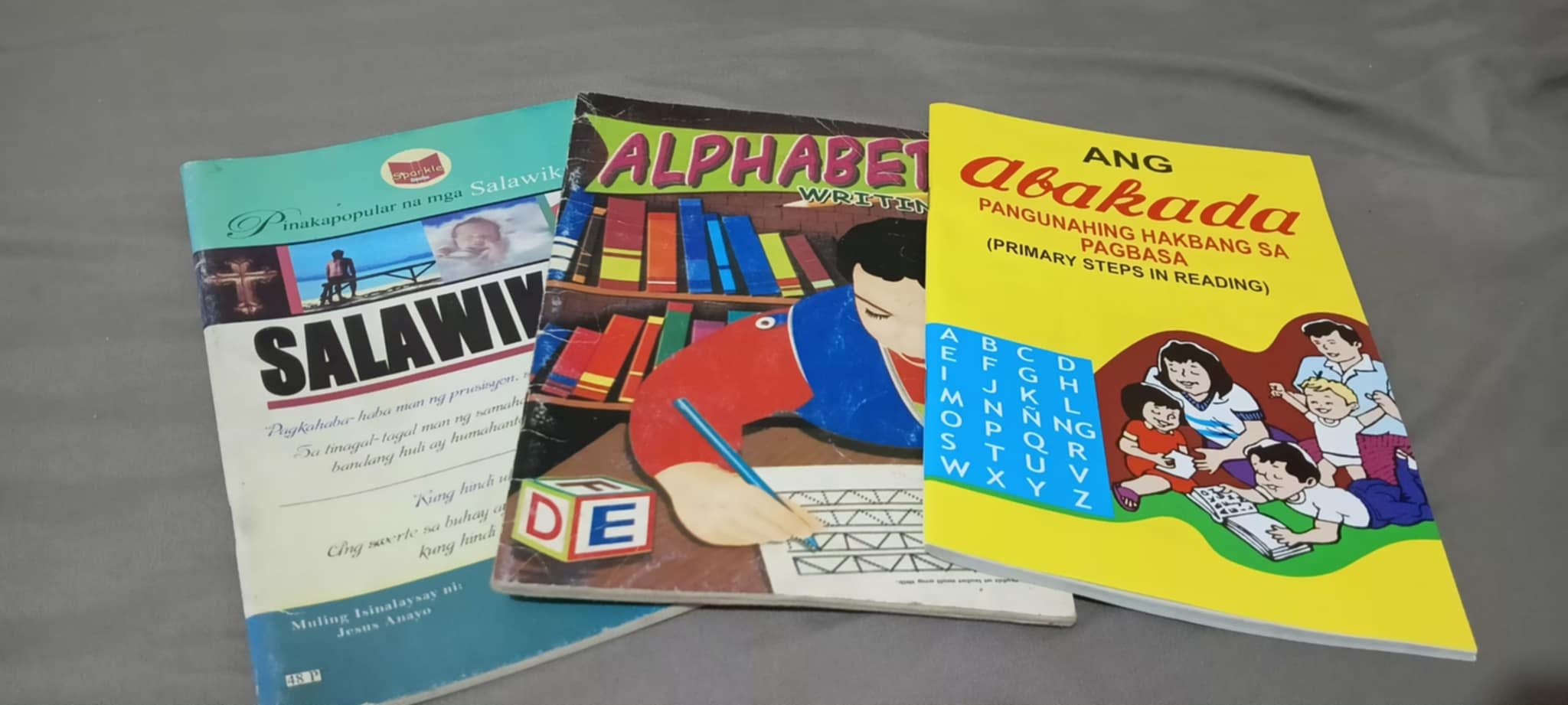
Now four* years old, I’m happy to share that my son reads Tagalog books and mainly converses in Filipino as well. He also speaks good English and loves reading a plethora of children’s stories that her mom buys from secondhand bookshops, as well as watching YouTube videos of Blippi manning trucks and excavators.
He can understand and sometimes speak several Ilokano words, too, thanks to his hands-on grandmother.
Since my wife hails from Nueva Ecija, a predominantly Tagalog-speaking province, our son also adopted some Tagalog words more commonly spoken in her hometown.
For example, he refers to sombrero as balanggot, maghugas [ng mga pinagkainan] as mag-urong, magbihis as gumayak, and the proverbial eka instead of saying sabi. Hearing my son enunciate these charming regional Tagalog words fills me with inexplicable joy.
A big part of me still believes, however, that fluently speaking English is a valuable skill, especially when seeking employment opportunities both locally and overseas. But it never should be made at the expense of failing to learn, and for that matter love, our own language in all its beauty, complexity, and peculiarity.
When the Supreme Court upheld the ‘constitutionality’ of CHEd’s removal of Filipino and Panitikan from the college curriculum in 2019, it was nothing short of appalling.
With the ubiquitous misuse of ng and nang, as evidenced by a multitude of posts perennially circulating across social media platforms, it suggests that retention of the subject in tertiary schools remains essential. Still, the importance of mastering our lingua franca should go far beyond overcoming these deceptively simple mistakes in grammar.
To truly cultivate a lifelong love of one’s country, it must begin with making the young learn the traditional language of their own people in their native soil. We must preserve our Pambansang Wika and other local dialects for posterity through institutionalized programs that advocate for their protection from what critics aptly call a cultural genocide.
A viral post about a young student who wrote “I hate Filipino” on his exam papers is a glaring reminder that Filipino parents like me must do better. Hearing our children speak English may feel good, a proud moment even. But it’d be a shame if it’s the only language they come to know and speak.
It’s not wrong to learn a different language other than our own, but it’s another story if our youth becomes too accustomed to speaking it that they begin to develop alienation for the very language that gives them, us, a unique cultural identity.
For whatever it’s worth, the delusional rookie dad in me who dreamed of having an English-only-speaking child has completely disappeared. Truth be told, I am mortified to have even implied, at one point in my life, that English is superior to other languages, instead of regarding it for what it simply is—a language.
Believe it or not, I could now care less about my son’s exceptional grasp of the English language, and more about him gaining friends, bonding with his cousins and grandparents, and making him love learning without force or pressure.
At this point, I’d be prouder to learn that my son received a near-perfect grade in his Filipino subject. Never mind that he committed petty grammatical errors in his English classes.
‘Tagalog only, please’ was first published in print via The Indiependent Collective’s anthology of essays, “Reflections.”